


Last week our interns gathered their first sets of benthic quadrat and photogrammetry surveys and this week they analysed that data using two programs: Coral.Net and TagLab. This post shows how CoralNet and TagLab, two powerful tools in coral research, are used to process and interpret the collected information. Through CoralNet’s machine learning capabilities and TagLab’s photogrammetry analysis, our interns gained deeper insights into coral ecosystems that they can use for their independent research projects. Understanding how these tools work is essential in advancing our efforts to monitor and protect these vital marine environments.
CoralNet
CoralNet is a web-based tool that automates the annotation of coral reef images using machine learning. It processes and identifies coral species, significantly reducing the need for manual analysis. Users upload images, and CoralNet’s algorithm detects and labels different species, with options for manual adjustments to ensure accuracy. As users provide input, the tool improves over time, making it more precise.
Widely used in coral monitoring, CoralNet helps track changes in coral cover and species composition, providing consistent, reproducible data that informs conservation strategies and management decisions.
Image Annotation in CoralNet
Image annotation starts with uploading coral survey images to CoralNet, where the platform’s machine learning algorithm automatically identifies and labels coral species and other organisms. Our interns can review and adjust these annotations to ensure accuracy, improving the algorithm’s performance over time.


Photogrammetry- Creating the Orthomosaic
Once initial training is complete, Photogrammetry Surveys are straightforward and can be completed by anyone with a GoPro, a transect, scale bars and Ground Control Points (GCP’s). The more difficult part comes in analysing the data, where the photos need to be rendered using an external software to create an orthomosaic. To do this our interns downloaded their photos to Metashape, a processing software that renders the photos to create a digital mesh and subsequently a 2D model that can be analysed in TagLab.
TagLab
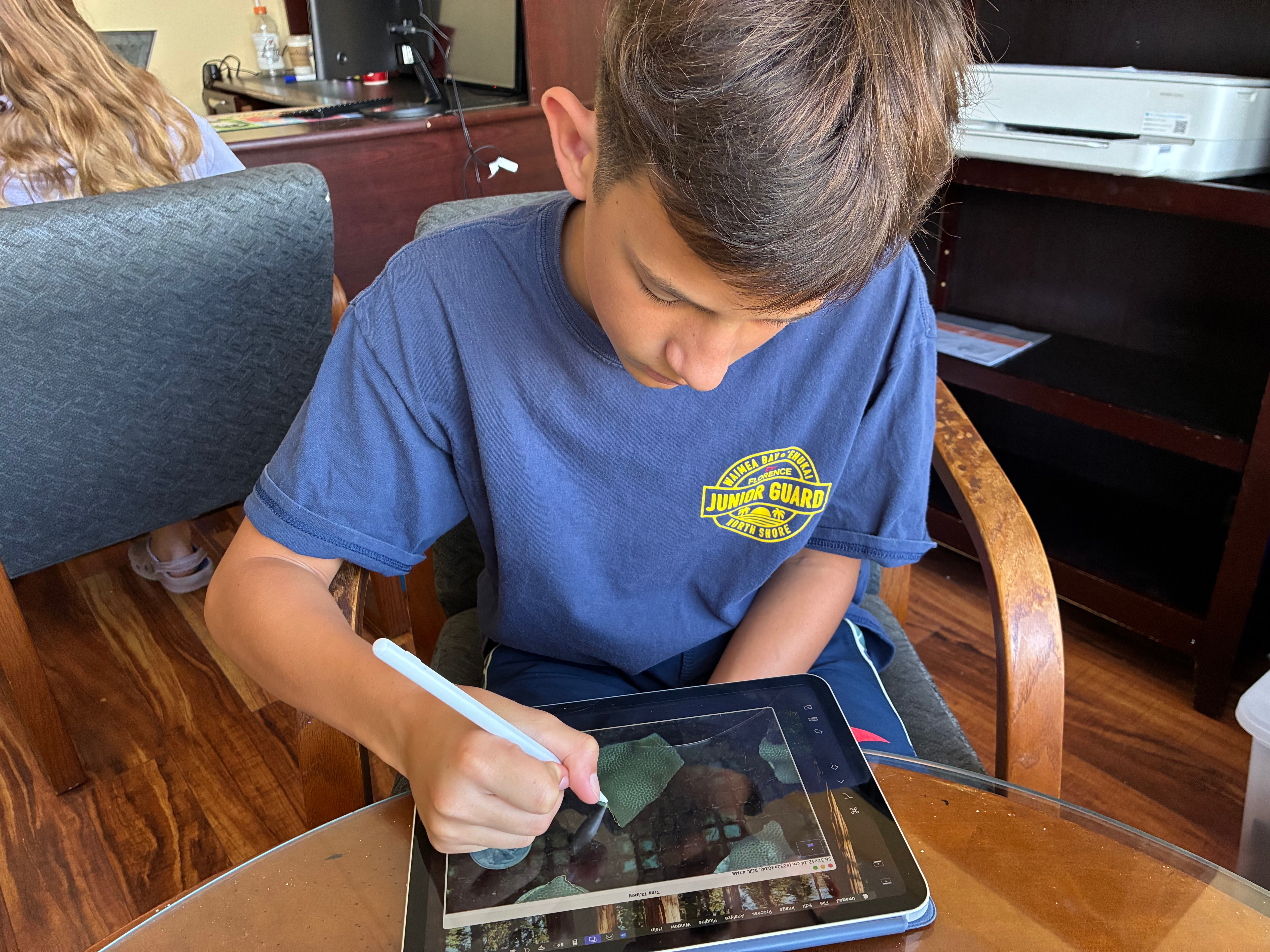
TagLab is a powerful tool for photogrammetric analysis, allowing researchers to create 3D models of coral reefs from 2D images. This enables precise measurements of coral structures, such as surface area and growth rates. Researchers import survey images into TagLab, annotate areas of interest, and generate detailed 3D models. The tool is essential for monitoring fine-scale changes in coral morphology and understanding environmental impacts. TagLab’s integration with GIS tools enhances spatial analysis, offering critical insights for assessing conservation efforts and understanding coral reef dynamics in a changing climate.
Finding surface area in TagLab


What’s on next week?
Next week, our interns will look at analysing this data for their independent research projects. As a part of their six-week internship, these interns will collect the data (this week), analyse the data (next week) and produce a final report answering a scientific question of their choice and present their findings (final week). We look forward to seeing how these students progress over the next few weeks and stay tuned to learn more about their independent research project next week.
How to Get Involved and Support Ocean Alliance Project
If you want to find out more about our internship opportunities, check out our upcoming programs:
- 1 Day Sea Turtle/ Coral Reef Conservationist Program: Learn More & Sign Up
- 4 Day Ecological Monitoring Program: Learn More & Sign Up
- 6 Week Marine Research Internship: Learn More & Sign Up
- 8 Week Scientific Divemaster Internship: Learn More & Sign Up
Or, if you’d like to support Ocean Alliance Project in other ways, consider donating or collaborating with us through the Get Involved section on our website.
Leave a Reply